Checklist / Glossiphoniidae / Haementeria / Haementeria lutzi
Haementeria lutzi
· Glossiphoniidae
External morphology
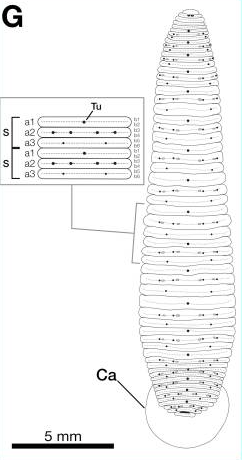
The ratio of total length to maximum body width is, in typical material, between 3.8 and 4.1. There are seven dorso-longitudinal rows of tubercles: one median (or sagittal) row and two latero-internal rows of warts situated on the same annulus (a2); two paramedian and two latero-internal rows are located on a different annulus of each somite. The capitulum is formed by annuli I through IV. The gonopores are separated by two annuli; the male gonopore is located at XI/XII, and the female at XII a2/(b5 + b6). The diameter of the posterior sucker is greater than half the maximum body width. Somites I and II are uniannulate; somite III is biannulate; somites IV through XXV are triannulate (or complete); and somites XXVI and XXVII are biannulate. The coloration is dark green or blackish, featuring a dark dorso-median longitudinal stripe; the central papillae are dark, while the lateral ones are lighter. 81 The posterior sucker is green on its ventral surface; the dorsal surface bears two concentric rows, each containing 12 light-colored spots.
Habitat & range
- Habitat
- Freshwater
- Region
- South America
- Recorded from
- Ecuador, Brazil
Original description
Pinto, ContribuiY?o ao estudo dos Hirudineos do Brasil (Trachybdella histriata novo genero e nova especie). (1920). Brazil Medico, 34, 624