Checklist / Glossiphoniidae / Palaemobdella / Palaemobdella horai
Palaemobdella horai
· Glossiphoniidae
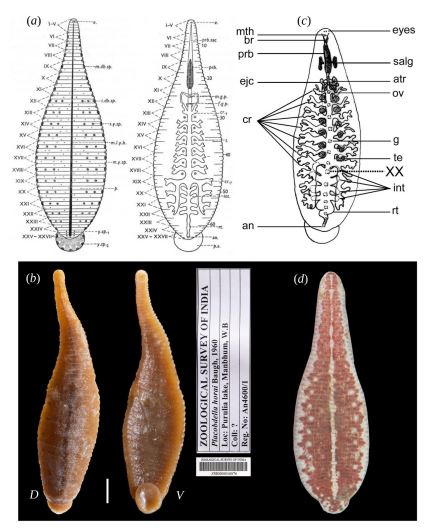
External morphology
Small leeches (length up to 12 mm); one pair of cup-shaped (sometimestriangular or round) eyespots on II (in some cases, eyespots are invisible but can be detectedhistologically as aggregations of visual cells); characteristic dorsal pigmentation patterns with deepchocolate brown ground color, yellow or white longitudinal medial band and lateral yellow or whiteband or large spots, two or four series of yellow or white spots at a2 (outer paramarginal or outerparamarginal and outer paramedian position); posterior sucker with yellow or white edge and a series oflight spots along the margin (Figure S5); body with 66-67 annuli, mid-body somites triannulate; dorsum is densely covered with small, closely set papillae; mouth pore is subterminal; onopores separated by two annuli:male gonopore on furrow XI a3 / XII a1 and female gonopore on furrow XII a2 / XII a3
Internal morphology
one pair of compact salivary glands; seven pairs of crop caeca; six pairs of testisacs; g
Habitat & range
- Habitat
- Freshwater
- Region
- Asia
- Recorded from
- Manbhum India
Biology
Shrimp and fish parasite
Junior synonyms
Placobdella horai
Original description
Baugh, S. C. (1960). Studies on Indian Rhynchobdellid leeches. I. Parasitology, 50(3–4), 287–301.