Checklist / Praobdellidae / Limnatis / Limnatis paluda
Limnatis paluda
Praobdellidae
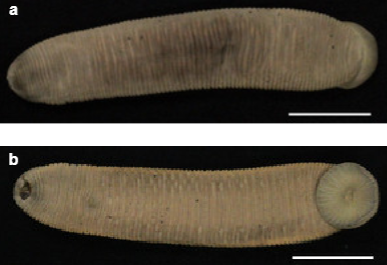
External morphology
Small to medium sized leeches up to 44 mm in living specimens. Lateral keels are absent. The ventral side of the body is flat. The monostichodont jaws in the pharynx are large, with 30 to 47 teeth and numerous salivary papillae. The caudal sucker is broad, almost broader than the maximum diameter of the body. The dorsal surface is generally unicoloured greenish-brown to black in living specimens. The marginal red-orange stripes are small or absent. The ventral side of the body is slightly brighter than the dorsal surface. The surface of the body is smooth, papillae are absent.
Habitat & range
- Habitat
- Freshwater
- Region
- Asia
- Recorded from
- Iran, Palestine, Central Asia
Taxonomic notes
In Neubert key: The status of this species is very doubtful. All specimens investigated from Turkey, the Levant and Yemen turned out to be Limnatis nilotica. In general, there are no major morphological differences between both species. However, recent genetic examination show delimitation between L. paluda and L. nilotica: 10.1080/14772000.2026.2628723 Recent genetic studies (e.g., Ayhan et al., 2024; Utevsky et al., 2022) have confirmed the validity of Limnatis nilotica, Limnatis paluda. Maximum likelihood (ML) and Bayesian inference (BI) shared the same topology (Fig. 7), showing distinct clustering of L. nilotica and L. paluda, with a structure represented by two clades (A and B) each with two subclades. Additionally, uncharacterized Limnatis cf. nilotica sequences from Namibia and
Croatia appear as separate lineages in each clade, suggesting potential cryptic diversity within the genus.Clade A contains mainly specimens identified as Limnatis paluda, originating from Kazakhstan,
Azerbaijan, Uzbekistan, Israel, Iran and Turkey. Within this clade the Romanian specimens identified as Limnatis bacescui (MGAB ANN013 and MGAB ANN014) do not form an independent lineage but instead cluster firmly within the widely distributed L. paluda clade. Their placement, supported by high posterior probabilities, suggests that L. bacescui is not genetically distinct from L. paluda. In contrast, in Clade B, L. nilotica and L. anouarensis form clearly separated and well-supported lineages, consistent with their current taxonomic status. These results support the synonymization of L. bacescui with L. paluda pending integrative taxonomic confirmation.
Sources used for this page
Description: ISBN 9783827409270