Checklist / Glossiphoniidae / Helobdella / Helobdella michaelseni
Helobdella michaelseni
· Glossiphoniidae
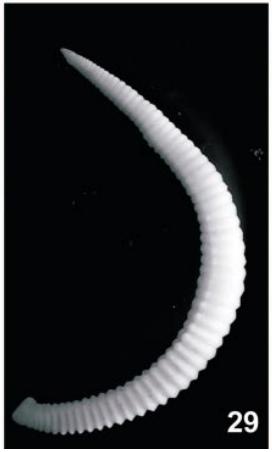
External morphology
Body linear, entirely non-foliaceous, subcylindrical, relatively narrow and thick. Devoid of papillae or tubercles. Neither a nuchal gland nor a chitinous dorsal plate is present. The cephalic lobe is inconspicuous, formed by segments I through IV. The cotyle is very small and subterminal, with an axis that extends that of the body. Two eyes are located on segment IV (subsegments a1 and a2). The gonopores are separated by a ring; the male gonopore is situated at the boundary of XII a1/a2, and the female at XII a2/a3. The anus is located between the last two rings—specifically, at the boundary of XXVI/XXVII. Somites I and II are uniannulate; III and IV are biannulate; V is biannulate or triannulate; VI through XXIV are triannulate (or complete); XXV is biannulate; and XXVI and XXVII are uniannulate. The mouth is situated within the concavity of the cotyle, at the level of somite III. The coloration is pale—slightly yellowish or lemon-colored—devoid of maculae or striae.
Internal morphology
The pharynx is straight, extending as far as the boundary of XII/XIII. The crop (or midgut) lacks lateral ceca, although it possesses six chambers that become globose when distended. There are seven pairs of testes, extending from the boundary of XIII/XIV to XIX/XX. The vasa deferentia follow an extensive descending or recurrent course. The transition in diameter from each vas deferens to the corresponding spermatic duct is abrupt. The pre-atrial course of the spermiducts forms an extensive loop that extends caudally as far as the boundary of XVII/XVIII.
Habitat & range
- Habitat
- Freshwater
- Region
- South America
- Recorded from
- Chile
Junior synonyms
Gloiobdella michaelseni