Checklist / Erpobdellidae / Erpobdella / Erpobdella monostriata
Erpobdella monostriata
· Erpobdellidae
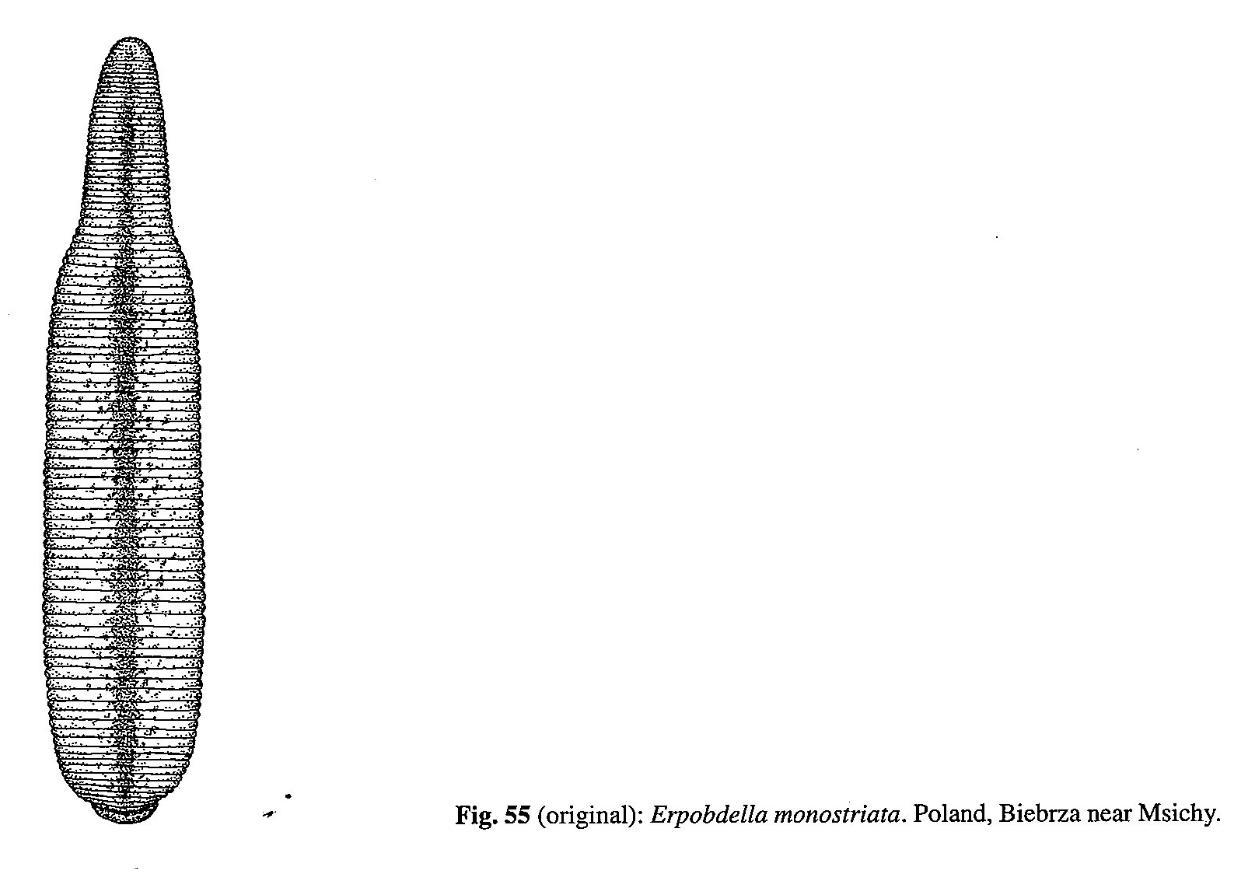
External morphology
Up to 30 mm. The anterior part of the body is cylindrical, the posterior part is slightly flattened. Pronounced lateral keels are absent. The genital pores are separated by four annuli. The body surface is smooth, papillae are absent. In living specimens, the body is a bright yellowish to brownish colour. Mid-dorsally, a characteristic dark longitudinal stripe occurs along the entire body without interruption. However, the stripe is faint and in many specimens clouds of darker pigment may occur. The ventral body surface is unicoloured and somewhat brighter than the dorsal side.
Habitat & range
- Habitat
- Freshwater
- Region
- Europe
- Recorded from
- Germany, Poland, Iran
Biology
This species prefers shallow water along lake shores where it can be found on the subsurface of stones, branches or similar structures. The preferred subsiratum is the gravelly bottom close to lacustrine springs, which guarantees a remarkably constant temperature regime throughout the year. It is also found in lenitic waters of rivers. Breeding takes place most intensively during June and July.
Original description
Lindenfeld, H., & Pietruszynski, J. (1890). Przyczynek do fauny pijavek krajowych (Hirudinei). Pamietnik Fizyjograficzny. 10: 399-437.
Sources used for this page
Picture: ISBN 9783827409270; Description: ISBN 9783827409270